
By Brendan Boyle, Director of Market Intelligence, Transparent Energy, June 2026
This article covers three topics: why summer electric prices tend to spike; what the summer of 2026 looks like specifically; and, in light of these two factors, what your company should do now to prepare. The official start of summer is just a few weeks away, but in the eyes of most electric utilities, the season has already begun.
For example, in most deregulated markets, capacity and/or transmission tags were reset on June 1st – timing pegged to the advent of the summer cooling season (i.e., heavy air-conditioning use) – and the monitoring period for 2027 has already begun. Clients that followed our guidance last summer and were able to curtail or load shift – key measures to reduce “cap and trans” tags – will begin reaping the benefits on their next power bill. In last month’s article we highlighted the mechanics behind increasing non-energy cost components, such as capacity and transmission. This summer, the Transparent Energy team will continue to send out grid alerts to help identify the hours when your company would benefit most by consuming less electricity.
Load shifting, curtailment, pre-cooling, and operational controls are all proven methods to drive down non-energy costs, which have become the biggest drivers of outsized increases on monthly energy bills. That said, we still need to consider the most expensive and volatile piece of the energy supply cost equation: the actual commodity itself, electrical energy.
‘Energy’ in this case refers to the electrons being produced by generation units and stored in batteries that power our homes and businesses. Energy is the highest cost component and by far the most volatile. And, almost universally, we see the most expensive energy prices during the winter and summer months – driven by temperature extremes.
Energy Prices Rise with the Temperature
Data from the National Oceanic and Atmospheric Administration (NOAA) shows that across the 131 years of U.S. recordkeeping, the 10 warmest years are packed into the last two decades, and nine of the ten have occurred since 2011.
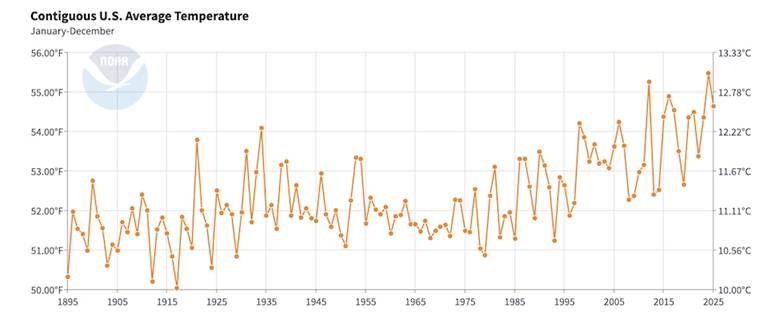
Source: NOAA
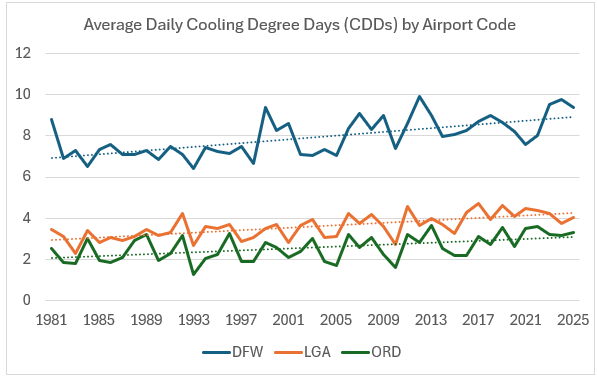
We see similar data when we look at Cooling Degree Days (CDDs), a measure of how much – and for how long – outside air temperature was above 65°F, a calculation used to estimate energy demand for cooling.
Weather stations at airports in Dallas, New York, and Chicago all show a steady upward trend in CDDs, meaning more energy is needed to maintain comfortable indoor temperatures:
From an electricity pricing standpoint, we can look back to 2024, the hottest year on record (2025 was the 4th warmest year). That summer was marked by extreme price volatility in the power sector. Here is a look at real-time prices during the summer of 2024 in those same three markets:
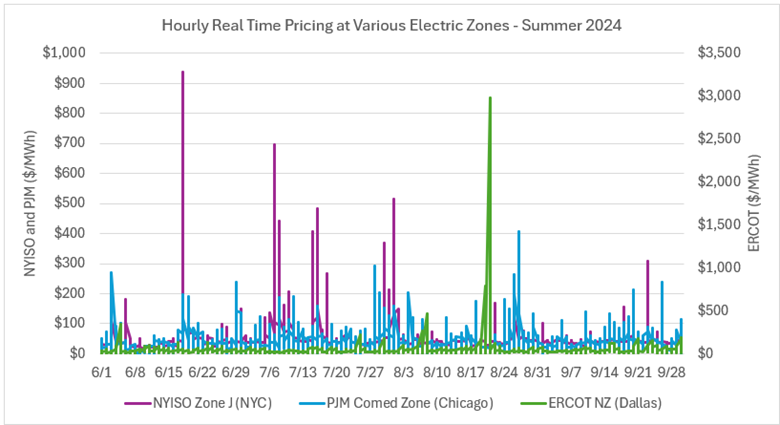
In the summer of 2024, real-time prices in New York reached $936 per MWh. PJM saw a max price of $408 per MWh. ERCOT’s North Zone requires a second vertical axis (right) to avoid skewing the data – the DFW Metroplex saw prices more than $2,980 per MWh. Keep in mind, these were not extended heat waves – merely a few consecutive days of above normal summer heat.
Looking ahead to the summer of 2026, the National Weather Service is calling for a warm summer across the lower 48 states; however, emerging El Niño conditions, which typically moderate summer heat in the continental U.S., are expected to lessen the likelihood of extreme temperatures in July and August.
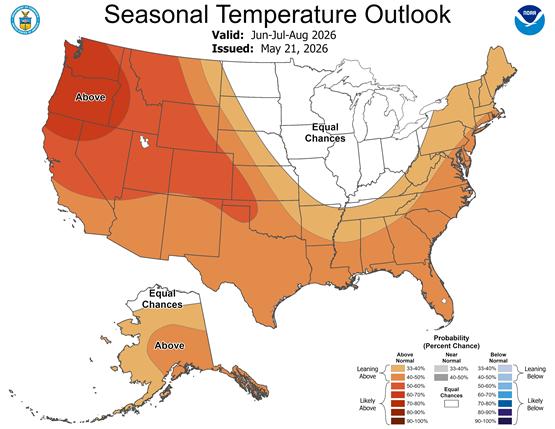
Source: NOAA
In its 2026 Summer risk profile the North American Electric Reliability Corporation (NERC) noted “rising demand, significant generation growth in many areas, the prospect of challenging hydrological conditions, and the unpredictability of large loads, from both a forecasting and operational perspective.”
The report concluded that the regions with the greatest risk of electricity supply shortfalls are New England, the Northwest, and parts of West Texas.
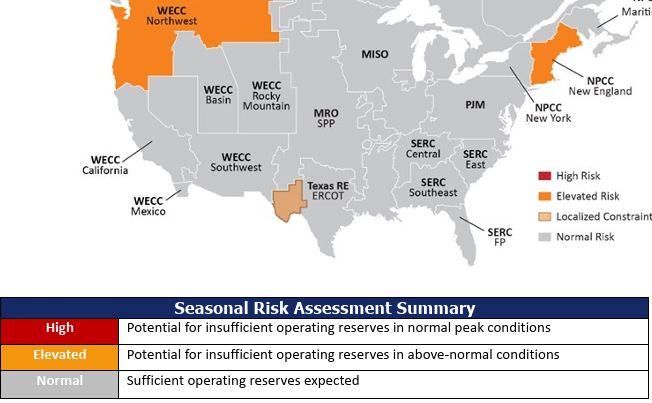
Source: NERC
The rest of the U.S. is expected to have sufficient summer operating reserves under normal conditions. Yet, in the event of heatwave, drought, or any number of other scenarios, these forecasts will change and electric prices are likely to follow suit.
What Does This Mean for My Business?
The most likely scenario is that summer weather patterns follow the consensus forecast, and that we see isolated price spikes, fewer hurricanes than normal, and forward prices remain near multi-year lows. In this case, late August/early September will present a great buying opportunity for forward contracts.
On the contrary, if temperatures come in hotter than expected, and major population centers experience extended above-normal temperatures, the impact will be felt in both the near-term and for years to come. In the aftermath of Winter Storm Fern (the February 2026 storm that disrupted gas supply across the Midwest), the price of natural gas for the winters of 2026/27 and 2027/28 shot higher in response. It would be reasonable to assume that an unexpectedly hot summer would send similar shockwaves through price strips for the summers of 2027, 2028 and beyond.
The bottom line is that you don’t want to find yourself buying electricity on the spot market at the last minute during the summer months — real-time and day-ahead prices can result in extremely high electric bills. End users that have not yet procured energy for the second half of 2026 would be wise to do so immediately.
Customers who have not yet decided for 2027 and beyond would do well to take an opportunity to review options. Executing a partial hedge in June allows protection against a worst-case scenario while allowing you to average costs lower if the summer turns out to be milder than expected.
Ultimately, now is the time to act. Temperatures are warming up, and the cost of energy is going to be profoundly impacted by how hot it gets, and how well the grid responds to ever-growing demand. Don’t wait until it is too late.
If you are interested in understanding how your supply contract can be impacted by summer weather — or if you want help understanding energy markets and building a procurement strategy that controls cost and reduces risk — contact Transparent Energy at LetsTalk@transparentedge.com.
Download article as PDFCategories:
More on News & Releases
-
Energy Procurement Is Risk Management
09.01.26
By Brendan Boyle, Director of Market Intelligence, Transparent Energy, September 2026 The Fed isn’t the only institution with a ‘dual mandate.’ At Transparent Energy we have one, too: 1. To...

-
Transparent Talk with Elgar Peerschke, Advisory Board Member
07.28.26
Q: Elgar, welcome to the Transparent Energy Advisory Board. By our count, you worked at “Big 5” Consulting firms for 25 years. Can you tell us a bit about what...

-
Myth Buster: Why ‘Shoulder Season’ Isn’t Best for Buying Energy
07.15.26
By Brendan Boyle, Director of Market Intelligence, Transparent Energy, July 2026 Seasoned energy buyers understand that the timing of an energy purchase is one of the most critical factors in...