
By Brendan Boyle, Director of Market Intelligence, Transparent Energy, June 2026
On July 1st, Virginia will rejoin the Regional Greenhouse Gas Initiative (RGGI, pronounced “Reggie”), a cooperative effort among eleven eastern states (CT, DE, ME, MD, MA, NH, NJ, NY, RI, VA, and VT) formed to reduce carbon dioxide emissions from the electric generation sector. RGGI is a market-based cap-and-invest program launched in 2005 that has been met with mixed opinions. Its implementation has led many to believe that commercial and industrial end users are paying too much for electricity.
The way the program works is simple: each participating state sets a limit on CO2 output from power plants sized 25 MW or greater. Generators must buy allowances equal to their emissions. The RGGI states sell these allowances and invest the funds from sales into energy efficiency improvement projects. The program touts several successes, including reduced pollution, improved air quality and public health, job creation, and, despite industry claims to the contrary, lower energy bills.
The environmental benefit comes with economic pitfalls. To many observers, end users are paying higher prices to support RGGI. Around 90% of RGGI allowances are distributed via quarterly auctions which establish a value for the right to emit greenhouse gases. The cap on tons of CO2 allowed diminishes each year, and, in recent years, the cost for each allowance has increased dramatically:
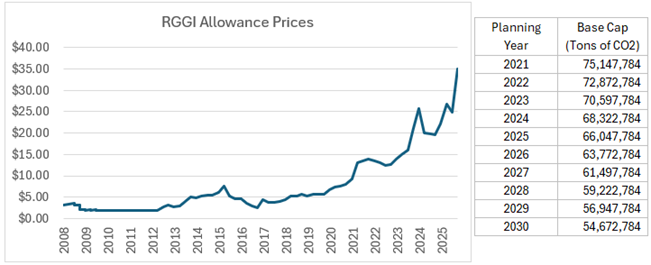
Source: RGGI Inc.
Since its inception, RGGI auctions have generated more than $9 billion in proceeds for the participating states. These costs are passed from power generators to end users in PJM, NYISO, and ISO-NE as part of the wholesale cost of electricity. To calculate how much RGGI adds to electricity prices, we use the following equation:
RGGI Adder ($/MWh) = Emissions Rate (lbs. CO2/kWh) ÷ 2,000 * RGGI Price per ton
The Emission Rate varies by fuel and efficiency:
| Fuel Type | Avg. Emission Rate | RGGI Adder @ $10/ton | RGGI Adder @ $25/Ton |
| Coal | ~2.2 lbs./kWh | $11.00/MWh | $27.50/MWh |
| Oil | ~1.6 lbs./kWh | $8.00/MWh | $22.00/MWh |
| Combined Cycle Gas | ~0.85 lbs./kWh | $4.25/MWh | $10.63/MWh |
| Peaker Gas | ~1.3 lbs./kWh | $6.50/MWh | $16.25/MWh |
As a general rule, every $1/per ton increase in the RGGI allowance moves the marginal cost of the average combined cycle gas turbine by $0.40 to $0.45 per MWh. That’s nearly half a cent per kWh for every dollar the auction price rises! At sustained high allowance prices, it becomes increasingly uneconomic to dispatch fossil-fueled generation. When zero-carbon resources cannot fully cover demand, the remaining fossil dispatch carries an embedded allowance cost that is ultimately reflected in wholesale clearing prices — a cost borne by all power consumers in the region. It is estimated that RGGI is embedding $8-12 per MWh into total wholesale electric prices, up sharply from $2-4 per MWh at the start of the decade.
There are several driving forces behind the steady increase in allowance prices. First is the declining baseline cap on emissions, which shrinks the annual tonnage of permissible CO2. Next is the unprecedented long-term demand growth which requires even more power generation. Finally, the addition of Virginia and its “Data Center Alley.” Virginia re-entering doesn’t flood the market with supply — it adds demand. Virginia’s initial allowance budget is anticipated to be smaller than its actual emissions, meaning Virginia will introduce a net increase in demand for allowances in the market.
What Do the RGGI States Do with the Auction Proceeds?
The most recent RGGI report shows that in 2023, $852 million in proceeds were invested in clean energy programs against nearly $1.5 billion in funds raised. The balance is held by the states to be deployed in the future as part of a multi-year funding plan. RGGI, Inc. estimates that the $852 million will return $2.7 billion in lifetime energy bill savings, though the methodology underlying this projection is not publicly detailed. Most of the investments (64%) go toward energy efficiency projects. Another 15% goes towards providing credits or financial relief on the utility bills of vulnerable residents and households.
New Jersey invests its RGGI proceeds toward meeting the state’s climate and clean energy goals. Funds are split among three agencies: 60% to the New Jersey Economic Development Authority, 20% to the NJ Board of Public Utilities, and 20% to the NJ Department of Environmental Protection. As a representative example, the Paterson, NJ Fire Department received a $261,034 grant to replace a gasoline-powered fire truck with an electric vehicle, a project projected to avoid 531 tons of CO2 and 12,555 MMBtu of energy consumption over its fifteen-year service life. Each participating state operates its own allocation framework and program priorities.
What Does This Mean for My Business?
RGGI adds a structural and growing layer of costs to power markets in participating states — on top of already rising capacity costs, tighter reserve margins, and global fuel supply disruptions. The case for RGGI is that it gives states a market-based tool to reduce emissions while recycling revenue into clean energy programs. The counterargument is that it raises costs for all power consumers, and elected officials facing constituent pressure are not always willing to absorb those costs in service of long-term environmental goals.
The bottom line for commercial and industrial buyers is straightforward: RGGI is not a line item that disappears. It is a growing structural cost embedded in wholesale power prices across the Northeast and Mid-Atlantic. For CFOs and procurement managers, understanding these cost drivers is the first step toward managing them. Fixed-price contracts, load reduction strategies, and well-timed procurement decisions can all help insulate your organization from continued allowance price escalation. The only way to stay ahead of these developments is by working with a professional advisory firm and maintaining a proactive, informed procurement strategy.
If you are interested in learning more about the Regional Greenhouse Gas Initiative — or if you want help understanding the cost components driving energy markets today, and what you can do to minimize cost increases — contact Transparent Energy at LetsTalk@transparentedge.com.
Download article as PDFCategories:
More on News & Releases
-
Energy Procurement Is Risk Management
09.01.26
By Brendan Boyle, Director of Market Intelligence, Transparent Energy, September 2026 The Fed isn’t the only institution with a ‘dual mandate.’ At Transparent Energy we have one, too: 1. To...

-
Transparent Talk with Elgar Peerschke, Advisory Board Member
07.28.26
Q: Elgar, welcome to the Transparent Energy Advisory Board. By our count, you worked at “Big 5” Consulting firms for 25 years. Can you tell us a bit about what...

-
Myth Buster: Why ‘Shoulder Season’ Isn’t Best for Buying Energy
07.15.26
By Brendan Boyle, Director of Market Intelligence, Transparent Energy, July 2026 Seasoned energy buyers understand that the timing of an energy purchase is one of the most critical factors in...