
By Brendan Boyle, Director of Market Intelligence, Transparent Energy, July 2026
Seasoned energy buyers understand that the timing of an energy purchase is one of the most critical factors in reducing costs and achieving budget stability. For decades, there has been a misconception that the best time to procure electricity and natural gas is during the ‘shoulder season’ – either in the spring or autumn when energy demand is lower, and prices tend to soften.
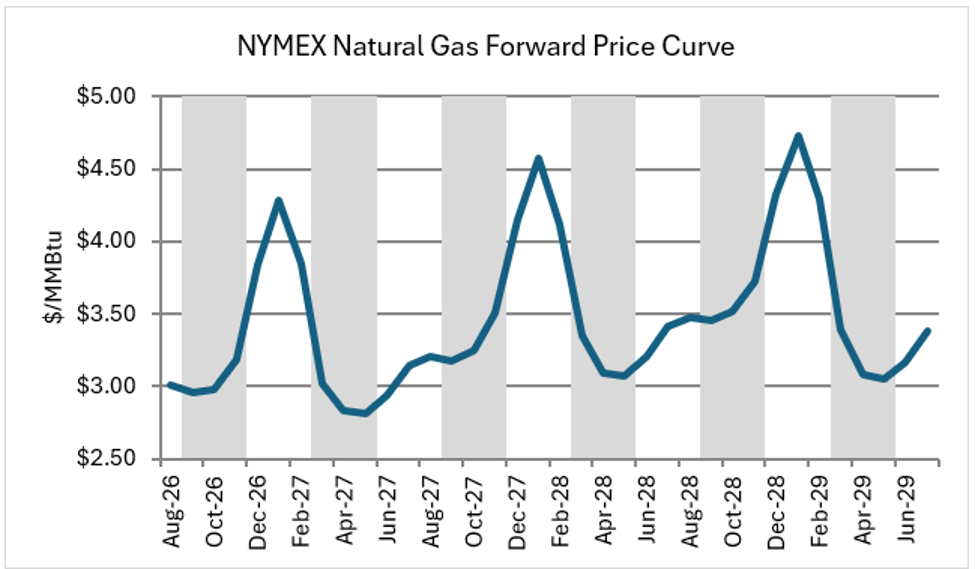
While a quick glance at the forward NYMEX natural gas curve shows prices are, in fact, lowest during these times of the year, as highlighted in the grey bars below, there’s more to the story.
Why the ‘Shoulder Season’ Buying Myth?
Real-time and spot energy prices are lowest during the non-summer/non-winter months; however, energy purchases are typically built around an annual or multi-year term. This requires an evaluation of the forward price strips. When a supplier quotes a fixed price, it is a volume-weighted average of monthly energy consumption multiplied by the forward price for each future month.
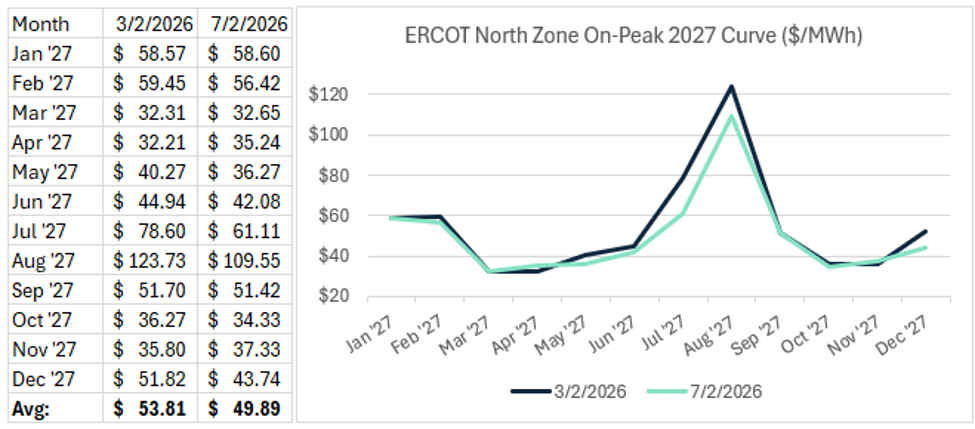
Just because spot prices are lowest during shoulder months does not mean that spring and fall are the best times to buy energy. Here is a look at forward electricity prices in Texas on two different dates. On March 2, 2026, a buyer looking to hedge 2027 electric costs would have done so at $53.81 per MWh. Four months later, during one of the hottest weeks of the year, that same strip of power was selling for $49.89 – more than 7% lower than the price earlier in the spring:
When is the Best Time to Procure Energy?
Any time of the year can present favorable opportunities to manage energy costs, structure purchases, and adjust your purchasing strategy. Typically, when forward prices are elevated relative to historical benchmarks, an energy buyer would be better served taking on more risk by assuming partial exposure to market indices. As we highlighted at the start of the year, situational awareness and flexibility are crucial elements of a long-term procurement strategy.
More important than ‘what time of year should I buy’ is ‘what time of year do I need to be hedged?’ Over the past several years, the answer to that question has become much clearer. While both summer and winter tend to yield higher prices and greater volatility, it is winter that has become the most dangerous time of year to be exposed to market-based energy rates.
Here is a look at the top 10 highest price days of electricity over the past 365 days in each of five markets — 50 data points in total (prices in $ per MWh):
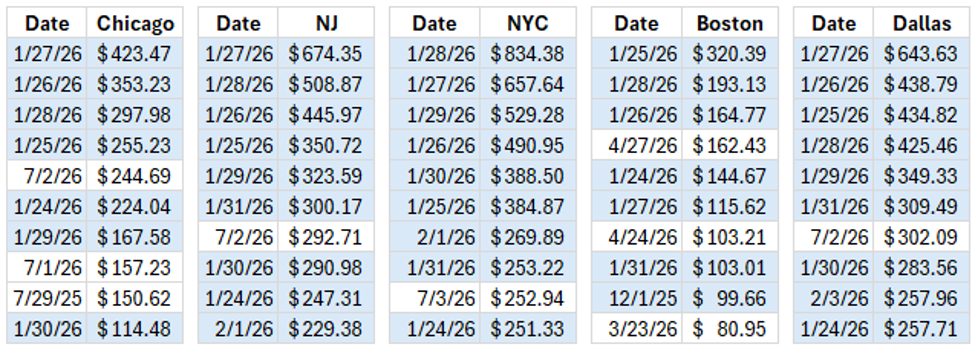
Highlighted in blue are days that occurred during the winter months. While there are a few summer days mixed in, only 9 of the 50 highest price days occurred outside of winter. While prices were certainly elevated ahead of the 4th of July holiday, the impact on pricing paled in comparison to the exceedingly expensive electricity prices that occurred over the past winter.
What Does This Mean for My Business?
Fortunately, the winter of 2026/2027 is still five months away. We strongly recommend that any power or natural gas user with exposure to winter prices begin working immediately to lock in rates for the upcoming winter.
If you have already secured a fixed rate beginning in December 2026, it would be prudent to look further ahead to the winters of 2027/2028, 2028/2029 and 2029/2030. Timing is important to capture future energy prices as dips occur in the market. It doesn’t matter which time of year you sign an energy contract — what matters is that you are protected during the periods when prices are most likely to move dramatically higher.
If you are interested in taking action to protect your energy budget against future price risk — or if you want help understanding the forces driving energy markets today — contact Transparent Energy at LetsTalk@transparentedge.com.
Download article as PDFCategories:
More on News & Releases
-
Energy Procurement Is Risk Management
09.01.26
By Brendan Boyle, Director of Market Intelligence, Transparent Energy, September 2026 The Fed isn’t the only institution with a ‘dual mandate.’ At Transparent Energy we have one, too: 1. To...

-
Transparent Talk with Elgar Peerschke, Advisory Board Member
07.28.26
Q: Elgar, welcome to the Transparent Energy Advisory Board. By our count, you worked at “Big 5” Consulting firms for 25 years. Can you tell us a bit about what...

-
Myth Buster: Why ‘Shoulder Season’ Isn’t Best for Buying Energy
07.15.26
By Brendan Boyle, Director of Market Intelligence, Transparent Energy, July 2026 Seasoned energy buyers understand that the timing of an energy purchase is one of the most critical factors in...