By Paul Shagawat, Co-Founder and Managing Partner, Transparent Energy
A Costly Disconnect
Educational institutions, whether pre-K facilities, K-12 Boards of Education or school districts, preparatory or technical schools, community colleges, or public and private colleges and universities, have been chronically underserved by the energy community and the cadre of consultants and aggregators meant to advance their interests.
Ever since we launched Transparent Energy 17+ years ago, we’ve noticed an alarming lassiez-faire attitude directed toward the education sector, one that perpetuates outdated energy-procurement strategies and methods that cost these centers of learning and community valuable budget dollars and growth opportunities.
This despite the fact that most campuses consume relatively large and predictable volumes of energy and pose little credit risk (characteristics retail energy suppliers like and will actively compete for). They also often are staffed by long-tenured facilities personnel and administrators deeply familiar with their buildings and energy needs, making them indispensable allies in the energy strategy and procurement process.
So why the disconnect? Why has the education sector too often been relegated to a second-tier of service and results rather than being treated as an elite buyer and user of energy?
Some of the answers lie in the differences between the public and private sector’s access to funding, risk tolerance, and reporting requirements. Others lie in old programmatic regimes that haven’t evolved with the times and rely on perpetuating a status quo that, objectively speaking, was never that great to begin with.
The Benefits of a Bespoke Approach
At Transparent Energy, we’ve procured electricity and natural gas for over 1,000 educational facilities across the U.S. Our proven approach is thorough: we work directly with our clients to understand their individual needs – how much energy they use (including where and when); what plans they have that might alter this use (for example, adding charging stations or rooftop solar; installing air conditioning); and current energy contract details – and develop a custom RFP to best market their procurement.
Next, using our online platform, we solicit an extensive list of vetted suppliers capable of meeting the customer’s load and service requirements.
Then things get really interesting. Transparent Energy “auctions” the educator’s energy load across a variety of product types and terms, soliciting bids in real time from multiple suppliers that provide unmatched market discovery, transparency, and an ultra-competitive dynamic that drives down prices.
Educational facility after educational facility marvels at the results. First, most can’t believe how many suppliers – in some cases as many as a dozen or more – participate in the auctions and how dramatically that competition drives down the resulting price of energy. For example, schools that rely on an energy broker or consultant often have one, two, or three suppliers in the mix at most, and receive a bid or two from each with the lowest price winning the contract.
In a Transparent Energy auction event, educators can expect to see hundreds of bids from 8-15 suppliers over the course of 15-20 minutes. In addition, every bid, in every auction is automatically captured and reported, providing decision makers a bullet-proof audit trail.
Contrast this highly competitive, real time, and transparent market with the aggregations many educators are used to working with. These aggregations are great for buying school supplies in bulk, but don’t do justice to the procurement of electricity and natural gas. A look under the covers often reveals aggregations working with the same “trusted supplier” term after term. Schools, Boards of Education, and school districts are then handed a price that relies on a disproven myth – that the extremely large aggregated load of a state’s or district’s schools automatically results in a discount.
Wrong.
Treating the disparate energy demands of schools across the state as a single load creates multiple risks for suppliers that result in them pricing in that risk and delivering a higher price than school’s should be paying. In auction after auction, Transparent Energy has amazed clients that have abandoned aggregation for a 21st-century technology and process-driven approach to energy procurement, one that results in lower prices and better products and terms matched to their individual situations, including planned or ongoing energy efficiency and sustainability initiatives.
See for Yourself
A closer look at the results customers across the education marketplace are achieving highlights the advantages of Transparent Energy’s auction-powered procurement approach and your opportunity to optimize the results of your learning institution’s next electricity and/or natural gas purchase.
Clifton Board of Education
This large N.J. Board of Education, which serves more than 11,000 students across 22 primary and secondary schools, broke away from using a state aggregation service for energy procurement and has flourished as a result. Over the course of several contracting periods, Transparent Energy has significantly increased competition for Clifton’s energy load, created cost savings, and reduced risk exposure.
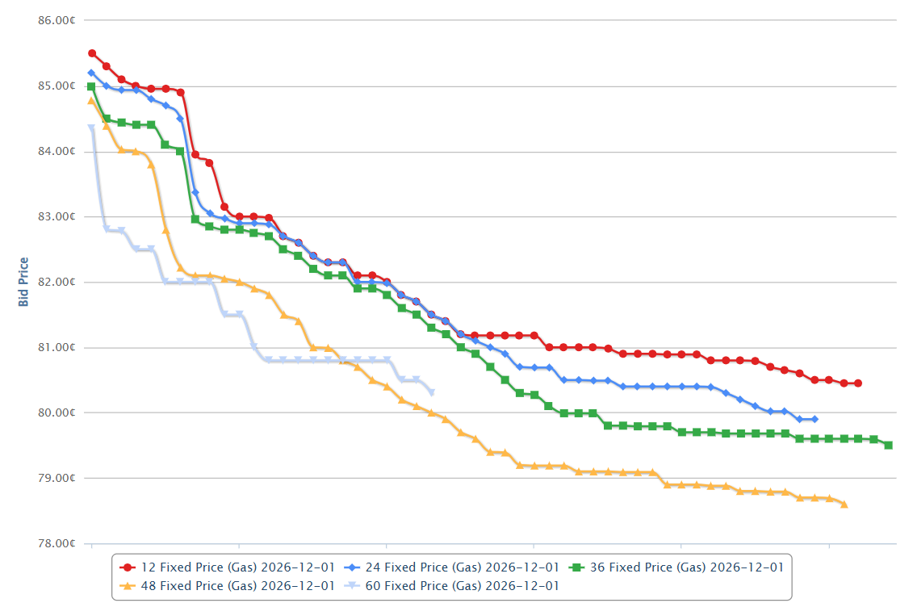
In 2026, against a backdrop of significant energy price increases and volatility, Transparent Energy brought the Clifton Board of Education back into the electricity and natural gas markets at an advantageous time to renew its contracts. The auctions delivered costs well below expectations and helped the school district secure favorable long-term, low-risk contracts. In all, the electricity auctions attracted 12 suppliers, who bid 297 times in 47 minutes. The natural gas auctions were also a big success, bringing together 8 suppliers, who bid 234 times to win the business.
The level of participation, the ferocity of the competition, the transparency of the process, and the resulting prices shed of supplier margins all stood in stark comparison to being handed a price by the aggregation every two years.
“We like working with Transparent Energy to make our strategic energy purchases,” said Michael Ucci, School Business Administrator at Clifton Board of Education. “Energy is a large expense for us, so anything we can do to better manage that cost is a win for Clifton residents and students. I’m glad we made the switch to Transparent Energy’s more proactive and competitive procurement process and look forward to achieving more great results together.”
(Read the full Clifton Board of Education case study here.)
Technical Schools, Colleges, and Universities
The campuses of colleges, universities, and technical schools are anything but “cookie cutter” in their diverse energy needs. While almost all have the standard mix of dormitories, classrooms, and administrative buildings, many also operate their own data centers and research labs, as well as athletic facilities, stores, and parking garages. They are not unlike small cities, with some assets running 24×7, others during the day, and others all night.
Some campuses even produce some of their own energy on site.
Simply put, these institutions require more than a one-size-fits-all approach to energy procurement. They need various products and terms, matched to each building or asset’s use case and rate class, and a skillful operator who knows how to present each to the market in a way most beneficial to the client.
One such technical institute had worked with the same energy consultant for 15 years, and, not coincidentally, with one energy supplier who had serviced the account for the majority of that time. Upon closer inspection, Transparent Energy detected that under this regime there was little correlation between the product types contracted (for example a fixed-rate contract vs. one that “floats” with the market) and the school’s risk tolerance or what was occurring at the site level.
Transparent Energy set the situation right, properly aggregating load across buildings by rate class while aligning fixed-price contracts where they mattered most to meet risk objectives.
And, remember that long-term incumbent supplier? Interestingly, and as is often the case, when Transparent Energy auctioned the school’s electric load, that supplier didn’t even finish in the top five – it was that far out of the money. Put more bluntly, the technical institute had trusted the supplier’s claim (parroted by their former advisor) that it was offering the “best price in the market,” but when tested in the auction, five other suppliers proved they were ready and willing to service their load for less.
That’s the power of the auction.
In a final deft move, Transparent Energy also helped the client score savings on its natural gas contract. The school operated its own natural-gas powered combined heat and power (CHP) plant to generate power for some of its assets, and Transparent Energy, understanding the desirability of this predictable 24x7x365 load, was able to market it, and auction it, to secure a much better rate, saving the institution thousands of dollars.
This eye on savings and extracting the best price from the market is a constant across all of Transparent Energy’s engagements with its education customers. For example, the firm helped another university up its energy-procurement game with an electricity auction that delivered more than a quarter of a million dollars in savings.
That relationship, dating back to 2019, now extends through 2030 due to a recent auction success that resulted in a 48-month supply term, providing the university with long-term price certainty and budget stability.
Over the course of this relationship, Transparent Energy has run 14 competitive energy procurement events – i.e., auctions – for the client and helped it bring new buildings, including facilities added via acquisition, into the fold of the university’s existing energy contracts.
Transparent Energy has worked with the university through multiple market cycles, continuously evaluating market conditions, contract structures, and term lengths to identify the most advantageous opportunities. Each procurement has leveraged Transparent Energy’s competitive process and broad supplier network to create meaningful competition for the University’s energy load and significant operational benefits.
Education in the Energy Winner’s Circle
Transparent Energy is active every day across all of the electricity and natural gas markets in the U.S., procuring energy on behalf of some of the world’s largest and most discerning energy buyers in the public and private sectors. We bring that skill, experience, and discipline, along with a deep-rooted desire to help our clients succeed, to every customer engagement, and are ready to enhance the energy-buying experience and improve the results of every educational institution interested in embracing a better way to procure energy.
Underserved and underappreciated no longer, Education belongs in the energy winner’s circle. Our commitment at Transparent Energy is to bring you there – and ensure you stay there procurement after procurement.
###
Today, Transparent Energy serves more than 1,000 educational facilities around the country, helping them modernize their energy management approach, manage risk, and reduce operating costs. For more information, contact Sara Horowitz at shorowitz@transparentedge.com.
Download article as PDFCategories:
Industries:
More on News & Releases
-
Underserved No Longer: How Transparent Energy is Helping Educators Excel at Energy Procurement
10.14.26
By Paul Shagawat, Co-Founder and Managing Partner, Transparent Energy A Costly Disconnect Educational institutions, whether pre-K facilities, K-12 Boards of Education or school districts, preparatory or technical schools, community colleges,...
-
Super El Niño – What It Could Mean for Energy Prices
09.28.26
By Brendan Boyle, Director of Market Intelligence, Transparent Energy, September 2026 Even the most seasoned procurement managers and energy advisors will acknowledge that it is nearly impossible to predict which...

-
Energy Procurement Is Risk Management
09.01.26
By Brendan Boyle, Director of Market Intelligence, Transparent Energy, September 2026 The Fed isn’t the only institution with a ‘dual mandate.’ At Transparent Energy we have one, too: 1. To...