By Brendan Boyle, Director of Market Intelligence, Transparent Energy
Capacity costs – Fees paid by electricity users to ensure enough power generation, storage, or demand-reduction resources are available to meet peak electricity demand and keep the grid reliable. (Source: FERC)
Introduction: Three Auctions Clear at the Ceiling
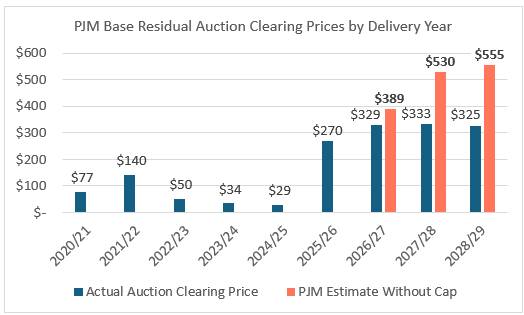
For most of the past decade, PJM capacity costs represented a relatively small component of electricity expenses for commercial and industrial (C&I) customers. That changed dramatically with the 2025/26 capacity auction, when prices increased more than 800%, from less than $30 to approximately $270 per MW-day.
Since then, capacity prices have continued to rise, hitting the FERC-approved price cap, i.e. the maximum price or “ceiling,” each time. For businesses operating in PJM, this has represented a significant increase in electricity costs.
With another auction approaching in December to determine capacity charges for 2029-30, and the current price cap scheduled to expire after that event, energy buyers need to understand what is driving these increases, how much further costs could rise, and what steps they can take to manage their exposure.
A Quick Look Back at PJM Capacity Auctions
The July 2026 auction for the 2028/29 delivery year was the third consecutive auction to clear at the price ceiling. It cleared at $325 per MW-day across all zones and procured 6,831 MW less than PJM’s stated reliability requirement. The preceding 2027/28 auction fell 6,500 MW below the reliability threshold. Those two auctions marked the first time in PJM’s history that the entire region fell short.
While customers are feeling the impact of higher capacity costs, the cap has provided some near-term protection. PJM’s market monitor estimates that, without the cap, the 2028/29 auction would have cleared at approximately $555 per MW-day—roughly 70% above the actual price. This is an estimate of the uncapped clearing price, not a forecast of future auction results. It illustrates how the price cap has limited near-term costs without resolving the underlying supply-and-demand imbalance.
For electricity buyers, the shortfall is an important warning sign: PJM has not secured enough capacity to meet its projected reliability requirement, underscoring the need to monitor market conditions and the potential for continued cost pressure.
Why Isn’t Supply Catching Up to Demand?
New power plants take years to permit, interconnect, and build. The December auction is not expected to close a gap of nearly 7 GW. Buyers should therefore plan for the possibility of another clearing price at or near the cap. PJM’s peak-load forecast for 2028/29 was 2,000 MW higher than the forecast used a year earlier, driven largely by new data centers. On the supply side, the auction cleared only 525 MW of new generation and uprates. Uprates are increases in generating capacity of a power plant or transmission system through efficiency improvements, delivering incremental megawatts at a fraction of the capital cost of building new generation. Most of the year-over-year increase in generating capacity came from changes such as higher accreditation values (the assigned value of how much power each plant can generate), rather than building new plants.
What Happens When the Price Cap Expires?
The current FERC-approved capacity price cap is scheduled to expire following the 2029/30 PJM auction. Unless another price limitation is approved, future auctions could reflect the underlying supply-and-demand imbalance more directly, meaning even higher prices for C&I customers.
The extent of any increase will depend on how much new generation and other qualifying capacity resources become available before the cap expires. As mentioned earlier, PJM’s market monitor estimated that the 2028/29 auction could have cleared at approximately $555 per MW-day without the existing price cap. Although that estimate is not a prediction of future clearing prices, it illustrates the potential financial exposure facing electricity buyers. Businesses negotiating electricity supply agreements that extend into the 2030s should understand how future capacity costs will be treated under their contracts and incorporate higher-cost scenarios into their long-term budgets.
Who Should Pay for the Cost of New Data Center Demand?
The rapid expansion of data centers is creating significant new electricity demand – and with it, capacity price pressure – across PJM. These facilities also create substantial requirements for additional generation, transmission, and distribution infrastructure.
The question facing regulators is who should ultimately pay for those investments? Several states are considering legislation that would require utilities to establish separate tariffs for large-load customers, including data centers. These measures are intended to ensure that costs associated with serving new, energy-intensive facilities are appropriately assigned to those customers rather than distributed across the broader customer base.
For existing C&I electricity buyers, the outcome matters. If new infrastructure costs are not appropriately allocated, businesses could face additional electricity expenses even if their own consumption remains unchanged. C&I buyers should monitor proposed utility tariffs and regulatory proceedings that could affect how these costs are recovered. PJM’s proposed one-time auction to address the 6,831 MW shortfall is also worth monitoring.
What Should Energy Buyers Do to Prepare?
- Budget through May 2030 as if the 2029/2030 auction will clear at the $325 price cap and prepare for even higher capacity costs beginning in 2030 and beyond.
- Put in effort to lower your peak load contribution. Shifting load, curtailing, and onsite generation during summer 5 coincident peak hours will help reduce the multiplier that you can control.
- Understand contract terms – make sure you have a firm grasp of how your energy supplier plans to address future changes in capacity costs. If you will be adding load, be sure to understand your utility company’s large-load tariff filings. New load could mean higher costs or collateral requirements.
- Revisit Demand Response. Now that each MW of electricity is more valuable, Demand Response programs are more profitable than they had been in the past. DR events are likely to be called more often than in prior years.
The Bottom Line
PJM’s capacity market has entered a period of elevated costs, and the underlying supply-and-demand challenges are unlikely to disappear overnight. With another auction approaching and the current price cap scheduled to expire after the 2029/30 auction, C&I electricity buyers should prepare for continued cost uncertainty through the end of the decade and beyond. Businesses that proactively manage peak demand, understand their electricity supply agreements, evaluate demand response opportunities, and monitor regulatory developments will be better positioned to control their electricity expenses. Decisions you make today could have a meaningful impact on your electricity budgets for years to come.
###
Need help understanding your PJM capacity exposure? Transparent Energy can help you evaluate your electricity supply agreements, identify opportunities to reduce capacity-related costs, and develop a strategy to manage future market uncertainty. Contact your Transparent Energy advisor to start the conversation or reach out to us at LetsTalk@TransparentEdge.com.
Download article as PDFCategories:
More on News & Releases
-
PJM Capacity Costs Are at the Ceiling: What C&I Electricity Buyers Need to Know about December’s Capacity Auction for 2029–2030
11.23.26
By Brendan Boyle, Director of Market Intelligence, Transparent Energy Capacity costs – Fees paid by electricity users to ensure enough power generation, storage, or demand-reduction resources are available to meet...
-
Transparent Energy Achieves Record Third Quarter Results as Large Energy Buyers Examine Legacy Energy Procurement Processes and Find Them Lacking
11.09.26
Annual and Total Contract Values Surge as Company Delivers Major New Customer Wins and Accelerates Renewals Fairfield, NJ – November 4, 2026 – Transparent Energy, the national leader in auction-based...

-
More Leverage, Less Friction – Using Technology and Competition to Strengthen Energy Procurement
10.22.26
How confident are you that your electricity and natural gas bids reflect the best pricing suppliers are willing to offer? Join Transparent Energy co-founder Paul Shagawat to explore how a...