By Brendan Boyle, Director of Market Intelligence, Transparent Energy
Record Production, Growing Demand
On September 17, 2026, U.S. dry natural gas production set a record of 113.7 billion cubic feet per day (Bcf/d), up 5.3% from a year earlier. As of October 2, the U.S. natural gas-directed rig count stood at 133, which is 13% higher than a year ago (Source: Baker Hughes). The U.S. Energy Information Administration (EIA) forecasts 2027 production to average 115.9 Bcf/d, up from 111.7 Bcf/d in 2026.
Rising supply is welcome news, because demand for natural gas continues to climb. Natural gas inventories are on track to finish October close to 4 trillion cubic feet (Tcf), about 2.5% above the five-year average, which would leave the country well supplied ahead of the upcoming winter.
Warm Winter Forecast Drives Down Near-Term Nat Gas Futures
As we noted just weeks ago, forecasts for December and January are trending warmer than normal across the northern U.S. As a result, calendar-year 2027 natural gas futures have dropped to the lowest level since February 2022:
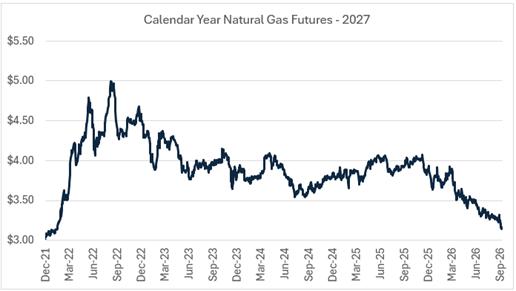
Source: NYMEX Henry Hub Futures Through Oct 5, 2026
The strong El Niño conditions that have emerged make it less likely that the upcoming winter will send gas prices sharply higher, as Winter Storm Fern did last winter. Several forecasters have raised the possibility that this winter could be the warmest on record; however, there are no guarantees.
Longer-Term Price Impacts of Growing Demand
What is far more certain is that demand for natural gas will continue to grow. Much of the growth in U.S. natural gas production is slated to feed LNG export terminals along the Texas and Louisiana Gulf Coast. Several new terminals are in various stages of commissioning, construction, and expansion.
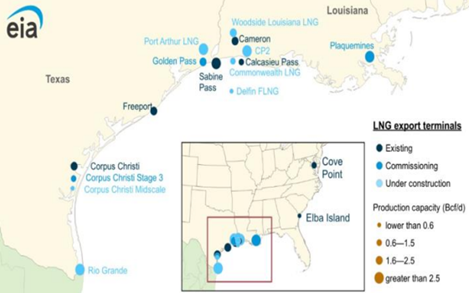
Source: U.S. Energy Information Administration
By the end of the decade, the U.S. is expected to export more than 30 Bcf/d of LNG to markets in Europe and Asia. Every molecule shipped overseas is one less available to refill U.S. storage. When inventories tighten, prices tend to respond quickly to the upside.
On top of the planned exports, the power sector is relying on natural gas more than ever. In deregulated electricity markets, roughly 40% of all power is generated by natural gas-fired plants. Here is a breakout of 2025 power generation fuel mix by region:
| ISO | Natural Gas | Nuclear | Renewables | Coal | Other |
| ERCOT | 41% | 8% | 37% | 13% | 1% |
| PJM | 43% | 32% | 8% | 16% | 1% |
| NYISO | 35%* | 30% | 26% | 0% | 9% |
| ISO-NE | 52% | 23% | 13% | 1% | 11% |
| MISO | 35% | 16% | 15% | 29% | 5% |
Source: ISO websites
Meanwhile, U.S. data center power demand is expected to more than double by 2030, and much of that new load will be served by natural gas. Because gas-fired plants set the marginal price of power in most hours in these markets, natural gas prices flow directly into wholesale electricity costs.
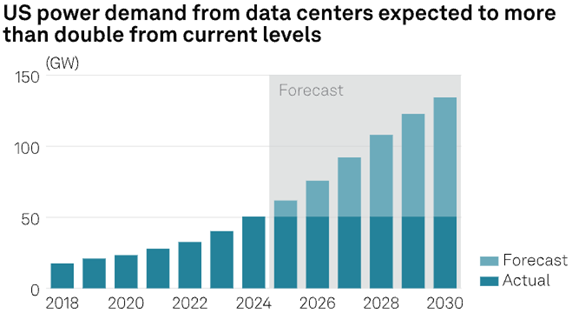
Source: S&P Global
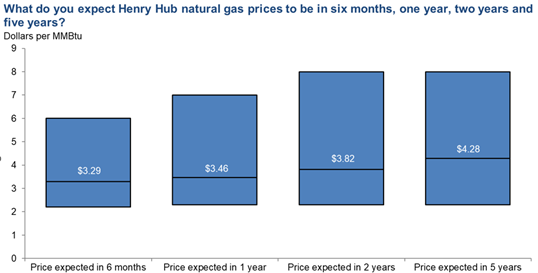
The Federal Reserve Bank of Dallas’s third-quarter 2026 Energy Survey of oil and gas executives suggests that the industry expects prices to trade above the current forward curve.
Source: Federal Reserve Bank of Dallas
For reference, during the survey collection period, Henry Hub spot prices averaged $2.97 per MMBtu. The main takeaway from the graphic above is the wide range of expected outcomes. None of the individuals polled expected prices to fall below $2 per MMBtu, but the highest forecasts reach $8. On average, respondents expect Henry Hub to reach $3.82 per MMBtu in two years and $4.28 in five years, both above today’s forward prices. In other words, the potential for prices to rise is far greater than the potential for them to fall.
Note: oil and gas executives tend to benefit from higher prices.
Now Is a Good Time to Buy. What Term Should You Choose?
At the start of October, NYMEX Henry Hub calendar strips for 2027 through 2030 are trading between $3.65 and $3.68 per MMBtu.
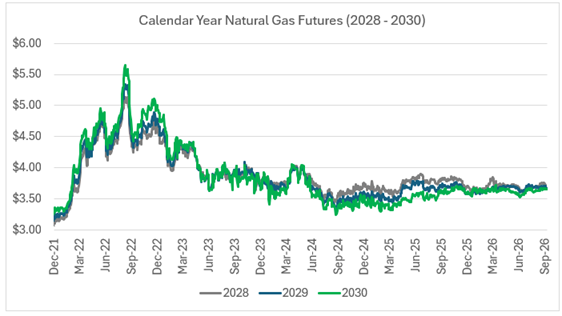
While not at their lows, prices beyond 2027 remain in a historically favorable range and offer an attractive opportunity to secure long-term price certainty at a relatively low cost. Our recommendation is simple: consider locking in a long-term (3 to 5 year) fixed price for at least 50% of your expected natural gas usage and leave the balance open. That way, if the market moves even lower, the open portion can capture added savings. In the more likely scenario that prices move higher, the fixed portion limits your exposure. Market conditions currently favor buyers, but the fundamentals suggest that today’s low prices could be short-lived. Now is an exciting time to be an energy buyer.
###
If you are interested in securing a low natural gas or electricity rate for your business, contact Transparent Energy at LetsTalk@transparentedge.com. This commentary reflects market conditions as of October 6, 2026, and is not a guarantee of future prices.
Download article as PDFCategories:
More on News & Releases
-
More Leverage, Less Friction – Using Technology and Competition to Strengthen Energy Procurement
10.22.26
How confident are you that your electricity and natural gas bids reflect the best pricing suppliers are willing to offer? Join Transparent Energy co-founder Paul Shagawat to explore how a...

-
A Beautiful Buying Opportunity: Forward Natural Gas Prices Fall to Multi-Year Lows
10.19.26
By Brendan Boyle, Director of Market Intelligence, Transparent Energy Record Production, Growing Demand On September 17, 2026, U.S. dry natural gas production set a record of 113.7 billion cubic feet...
-
Underserved No Longer: How Transparent Energy is Helping Educators Excel at Energy Procurement
10.14.26
By Paul Shagawat, Co-Founder and Managing Partner, Transparent Energy A Costly Disconnect Educational institutions, whether pre-K facilities, K-12 Boards of Education or school districts, preparatory or technical schools, community colleges,...