
By Brendan Boyle, Director of Market Intelligence, Transparent Energy, September 2026
The Fed isn’t the only institution with a ‘dual mandate.’ At Transparent Energy we have one, too:
1. To help our customers save money on energy however possible.
2. To help our customers manage the risk associated with energy procurement.
We address the savings side of this mandate through our meticulous procurement process, one capped off by online auctions that are the envy of the industry and which reliably delivers 7-8% savings over other energy procurement methods.
Today we want to focus on the ‘risk’ side of the ledger
All businesses that use equipment, machinery, lights, and HVAC systems are naturally ‘short’ electricity and natural gas (that is, you consume the commodity rather than produce it, so rising prices flow straight through to your cost of operations), which presents a need for risk management.
Energy procurement, when done correctly, is risk management.
Just How Volatile are Energy Prices?
Fortunately, U.S. natural gas production is relatively predictable, and the hydrocarbon molecules that are not burned to fire powerplants or heat homes can be reliably stored underground to be used when needed. Applying the classical notion of volatility – the standard deviation of returns over a specific time horizon – daily price volatility for commodities like crude oil and natural gas runs around 2-4%. This is slightly more volatile than a stock index (1-1.5%) and much more unpredictable than a treasury bill (<0.5%).
Electricity is not simply more volatile; it behaves in an entirely different category. Wholesale electricity prices can see daily volatility of ~23%. Here is a look at daily settlement prices for PJM electricity compared to the S&P 500 index:
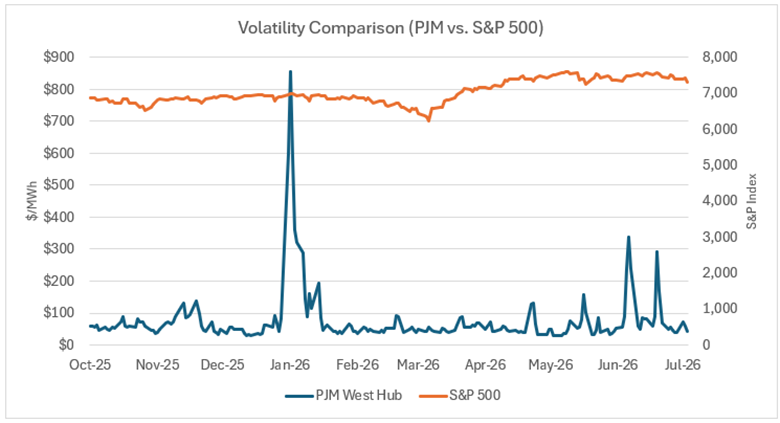
During periods of peak demand, electricity supply becomes almost completely inelastic, so small unanticipated outages can cause marginal prices to skyrocket. And unlike a stock, there’s no cost-effective storage mechanism for electricity at scale. We saw this play out during the late June/early July heat wave. Electricity’s daily volatility is often higher than the S&P 500’s entire annual volatility.
What is the Best Way to Manage this Risk?
Third-party electric and natural gas suppliers provide one primary service: they will assume up to 100% of your company’s energy price risk exposure. By offering a fixed, all-inclusive rate with an unlimited consumption tolerance, you can be assured that energy costs will be stable during the term of the agreement.
Sounds straightforward. Obtain quotes from a handful of suppliers and choose the lowest fixed rate offered, right?
Not so fast.
Ironically, when locking in a fixed rate, you are inherently taking on risk. What happens if you sign a long-term agreement and the market subsequently drops dramatically? That would put you at a competitive disadvantage with very little flexibility.
The best way to manage risk is to understand the wide range of potential outcomes and determine which course of action will yield the optimal result for your business. There are pros and cons that need to be evaluated at every step of the procurement process. How much risk is acceptable? Can our budget allow for large swings from one month to the next? Will we be protected if our operation expands, or if we sell an asset?
What Are Some Practices to Avoid?
Below are examples of mistakes made by energy buyers that can lead to improper risk management:
- Waiting until your contract is about to expire before sourcing the market. We recommend beginning the procurement process at a minimum of 12 to 18 months prior to current contract expiry. In many cases, this begins with price discovery and continues as market tracking. There is no obligation to lock in a future start date this far in advance, but it allows for optionality (i.e., choice!). In the days and weeks leading up to contract expiration, that optionality dwindles, and you become a price taker. It is very rare that the market coincidentally bottoms out at the same time your energy contract is set to expire.
- Buying for 100% of forecast consumption volumes at one price. Analogous to waiting until contract expiry to buy, going all in at a single price point reduces optionality. A layered hedge approach works much better, allowing for multiple ‘bites at the pricing apple.’ Stepping into a hedge over multiple tranches increases the odds of achieving the lowest weighted-average price.
- Ignoring contract language. This can take many forms. It is essential to match your energy contract with the way your business operates. Consumption swing provisions, payment terms, add/delete provisions, cost components, change in law, material change, and countless other small factors can add up to have a major budgetary impact. Make sure you understand the potential pitfalls and structure a contract that works to match your operational needs.
- Overlooking capacity and transmission charges. This is especially important from a budgetary perspective. Capacity and transmission charges often change from one year to the next. Most power contracts will bilaterally pass through these costs using a change in law provision. Most market reports focus on the commodity price, but there are other costs that add up to make energy one of the most expensive line items on an annual budget.
Takeaways
Sound complicated? It is. Working with your Transparent Energy advisor takes the guesswork out of energy procurement.
A confident energy buyer rarely has regrets. Determining when to buy and selecting a term becomes less crucial once you recognize that energy procurement is an ongoing process requiring regular maintenance. Taking an active approach towards energy buying allows for flexibility and rate optimization. Doing so with the right partner further increases your odds of success.
***
If you are interested in taking action to protect your energy budget against future price risk — or if you want help understanding the forces driving energy markets today — contact Transparent Energy at LetsTalk@transparentedge.com.
Download article as PDFCategories:
More on News & Releases
-
Underserved No Longer: How Transparent Energy is Helping Educators Excel at Energy Procurement
10.14.26
By Paul Shagawat, Co-Founder and Managing Partner, Transparent Energy A Costly Disconnect Educational institutions, whether pre-K facilities, K-12 Boards of Education or school districts, preparatory or technical schools, community colleges,...

-
Super El Niño – What It Could Mean for Energy Prices
09.28.26
By Brendan Boyle, Director of Market Intelligence, Transparent Energy, September 2026 Even the most seasoned procurement managers and energy advisors will acknowledge that it is nearly impossible to predict which...

-
Energy Procurement Is Risk Management
09.01.26
By Brendan Boyle, Director of Market Intelligence, Transparent Energy, September 2026 The Fed isn’t the only institution with a ‘dual mandate.’ At Transparent Energy we have one, too: 1. To...